THE WIZARD OF THE WOOD

The following article was written by David Banks in Sept 2020 for Witley Oral History Group, to celebrate Bede Howell’s contribution to the village in the planning and maintenance of Woodbury Hill.
Woodbury Hill is 136 acres and includes a Celtic Camp with an earth bank encompassing 22 acres. It is approximately 55 BC. Until 1922 it was owned by Lord Dudley and formed part of the Witley Court Estate. In 1922 it was sold to Norman Lees who lived at Home Farm for an unknown sum.
Norman Lees sold Woodbury Hill to John, Frederick Chater Brinton (of Red Marley, Great Witley) in 1958 for £2,800. I.e. £20.58 per acre.
At the time the hill was basically derelict with bracken and brambles, albeit there were a few old hulk trees and a ring of conifers on the highest point which were believed to be planted to commemorate one of the Jubilees of Queen Victoria. The ring still remains today. John Brinton was on the board of Directors of Brinton’s carpets and was paying Super Tax on his considerable income and decided to tackle Woodbury Hill head on by employing West Midland Woodland to manage the replanting of the whole of Woodbury Hill. Major Pilling set up a firm called West Midland Woodland (now Abbey Forestry) and Bede Howell, then a young and very enthusiastic forester was working for Major Pilling. Most of the replanting was done between 1958 and 1965. Bede Howell employed two full time men, namely Jim Rawlings, whose family lived in The Glebe and Bert Mills who lived at No 1 Yarhampton Cottages.
In 1958 Major Pilling and Bede planted up the hill fort of approximately 22 acres, which at that time was in pasture, with a cabbage planter. This worked very well as there were no old tree stumps and it was easy planting. The trees mainly of Scots Pine, Corsican Pine, Douglas Fir and Sitkas Spruce have done very well and although thinned many a time the final crop stands proud after 62 years.
Although the planting was completed on Woodbury Hill in about 1965 it required a vast amount of management and regular weeding of the young crops. All this was managed by the Wizard of the Wood, Bede Howell.
Before long Bede had to plan ahead for the first thinning being harvested and the Pickling Shed built down at the bottom of the wood opposite Home Farm used to house a bench saw and two big wrought iron pickling tanks with coal fires underneath them to heat the tar up into which hundreds and thousands of first thinning stakes were hot creosoted for the fencing market. Bede oversaw everything including the sales of produce.
John Brinton died and left the wood to his daughter Victoria in about 1970. She lived away and was not particularly interested and sold it in 1976 to Anthony Wilson for £33,500. Bede was retained by Anthony Wilson to continue to manage Woodbury but funds were somewhat lacking and the important thinning got behind. Anthony Wilson died in 1993 and John Clegg and Co. placed the Woodland on the Open Market. David Banks had only just bought Lippetts Farm but the opportunity of buying somewhere like Woodbury Hill only comes once in a lifetime and he had to scrape funds together to acquire Woodbury Hill in 1994 for £165,000.
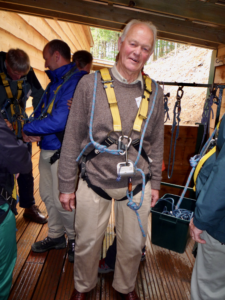
Dear Bede was thrilled that I purchased the wood and gave me a lot of encouragement and help including marking out numerous timber extraction rides through the wood and indeed preparing a new Woodland Management scheme. He also organised quite a few new plantings on Lippetts Farm including an arboretum on a three acre area of land between Lippetts Farm and Woodbury Hill.
Bede encouraged me to join the Royal Forestry Society which had several society meeting each year on various estates and he was always the centre of attention at these meetings, because of his shear character, humour, knowledge and other unforgettable attributes.

Dear David
What lovely memories of Dad, thank you so much for recording them for posterity.
Best wishes
Judith